Pivot Walking:
Learning a Whole-Body Pivot-Walking Gait
for Heavy-Box Transport with a Humanoid
IEEE-RAS International Conference on Humanoid Robots (Humanoids 2026)
 arXiv
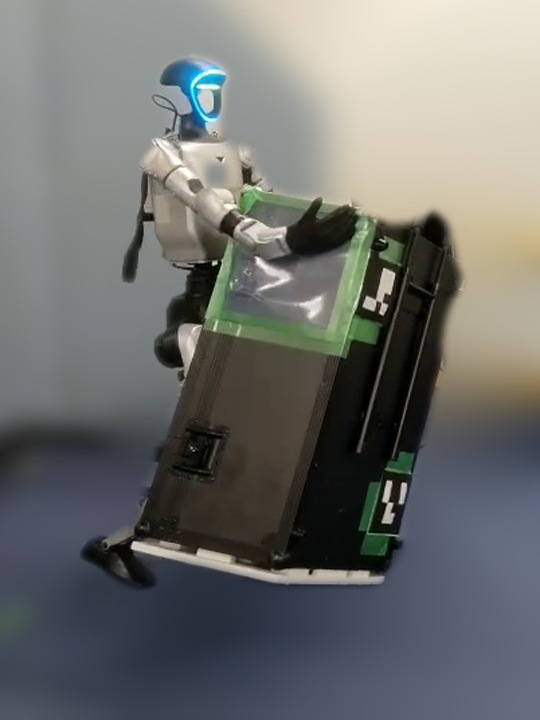
Abstract
Through pivot walking, humans can transport objects that are too heavy to lift. Previous humanoid studies have relied on planned sequences in which object manipulation and stepping are executed separately and the object is brought to rest between successive rotations. However, few studies have developed a single learned controller for humanoid pivot walking. In this paper, we propose a single reinforcement-learning policy that jointly coordinates stepping, balance control, and object manipulation. The policy is trained using rewards that promote alternating pivot motions and a phase reference that progresses according to the displacement of the object. In simulation, we confirmed that the humanoid can pivot a box. For deployment, we fine-tuned the policy into an object-blind version that follows a periodic clock instead of the progress reference. On the real robot, the deployed policy transported the box forward by more than 1 m in all five trials; each trial ended at a base-tilt safety stop. These results demonstrate that coordinated humanoid pivot walking can be learned with reinforcement learning and transferred to a physical humanoid robot without direct object-state sensing.
Learning the Pivot-Walking Gait
Moving a box forward can earn a reward even when the robot drags it. Across six training routes that rewarded the transport outcome alone, five learned to drag the tilted box and one learned a push that repeatedly toppled it.
We trained a whole-body policy with rewards for alternating pivots. In simulation, the box’s forward travel sets the rhythm for switching sides. For hardware, we fine-tuned a policy that follows a periodic clock and uses the robot’s own sensors, without measuring the box pose.
Simulation Experiments
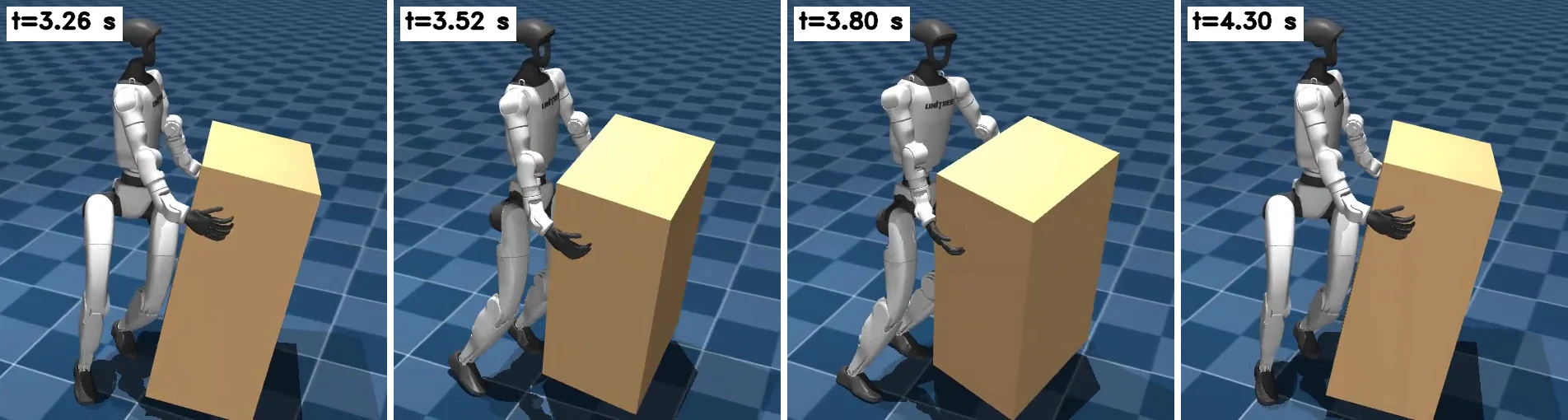
With a 14.9 kg box, the policy that observes the box averaged 4.12 m of accumulated forward travel in 20 s across 128 initial conditions. This measure sums the positive increments of box motion. All 128 runs reached the end of the evaluation window.
The four frames below show one alternating cycle of a separate, posture-refined policy with the same box mass.
Hardware Experiments
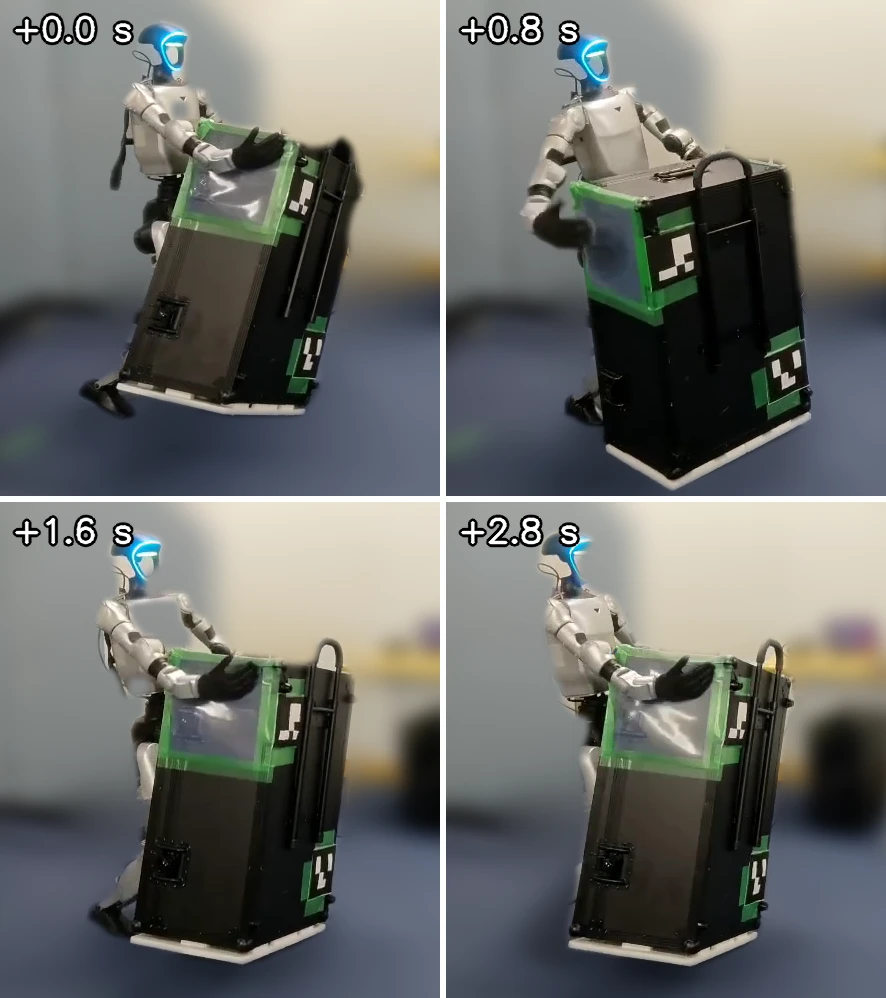
The deployed policy reproduced the alternating gait in all five trials. The gait lasted 16.2 ± 3.0 s, with an estimated active-gait speed of 0.11 ± 0.01 m/s (mean ± standard deviation). We estimated speed from video markers, fitting the distance scale using the two trials that ended upright.
Each trial ended when the robot reached its base-tilt limit. The robot then fell in all five trials, and the box toppled in two. The four frames show one alternating lean cycle. Times are relative to the first frame, and the background is blurred.
Video
The video shows the gait in simulation and on the physical robot, including all five hardware trials and their endings.
Humanoid Pivot Walking
Bibtex
@inproceedings{hidaka2026pivotwalking,
  author    = {Hidaka, Rikuto and Chen, Tsung-Yuan and Kawaharazuka, Kento},
  title     = {Learning a Whole-Body Pivot-Walking Gait for Heavy-Box Transport with a Humanoid},
  booktitle = {2026 IEEE-RAS 25th International Conference on Humanoid Robots (Humanoids)},
  year      = {2026}
}
Contact
For questions about this work, please contact Rikuto Hidaka (rhdkreal@gmail.com).